

[NEWS] Space Shift Develops “Eclipse band,” a Proprietary Technology to Maximize the Value of SAR Satellite Data — Research Results to be Presented at JpGU-AGU 2026
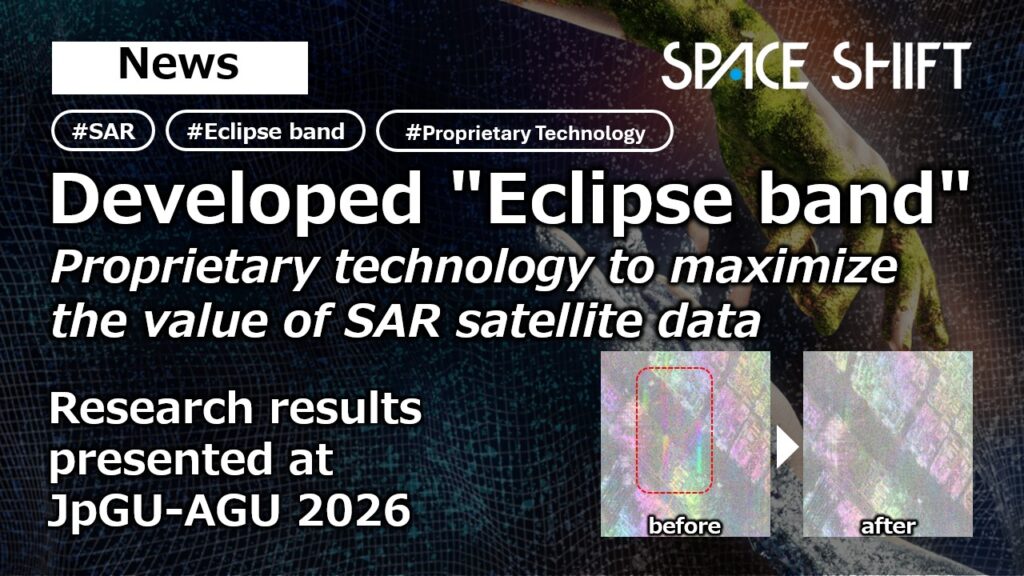
Space Shift has developed “Eclipse band,” a proprietary signal processing methodology that reduces “azimuth ambiguity”—an inherent phenomenon in Synthetic Aperture Radar (SAR) satellite imagery dictated by its observation principles—while maintaining the spatial resolution along the azimuth direction. A patent application for the invention regarding this methodology has already been filed in Japan (Patent Pending).
The research results were presented on Friday, May 29, 2026, at the international conference “JpGU-AGU Joint Meeting 2026” during the session “S-TT49: Synthetic Aperture Radar and its Applications.”
Technology Overview
In SAR imagery, an inherent phenomenon known as “azimuth ambiguity” is widely recognized, where signals from objects other than the intended target appear due to the underlying observation principles. Conventionally, a common mitigation approach involved dividing the observation aperture; however, this method posed a significant challenge as it inherently accompanied a degradation in azimuth resolution.
▶Space Shift’s Solution: “Eclipse band”
“Eclipse band” is our proprietary signal processing approach designed to break through this trade-off. Specifically, it enables the reduction of azimuth ambiguity without sacrificing azimuth resolution by integrating the following processing workflow:
- Generating multiple sub-images where a specific portion of the wideband observation signal is intentionally omitted (partially-missing);
- Cross-referencing these sub-images at the pixel level to differentiate between components originating from the intended targets and undesirable components stemming from side-lobes;
- Replacing only the pixels identified as undesirable components from the full-aperture image.
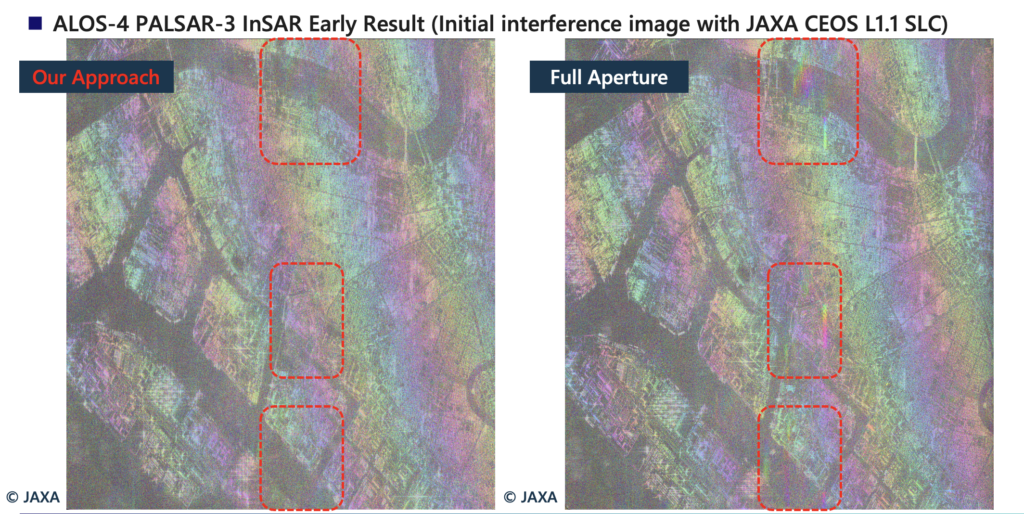
Figure: Comparison between the proposed method with “Eclipse band” (left) and the conventional method (right)
(Note: Interferometric phase images from Interferometric SAR (InSAR). Focusing on the areas enclosed by the red dashed boxes, the conventional method suffers from distorted interferometric fringes due to ambiguity-induced noise. In contrast, the proposed method effectively suppresses this impact, yielding much clearer interferometric phases. This demonstrates that the proposed approach enables significantly more accurate phase difference analysis.)
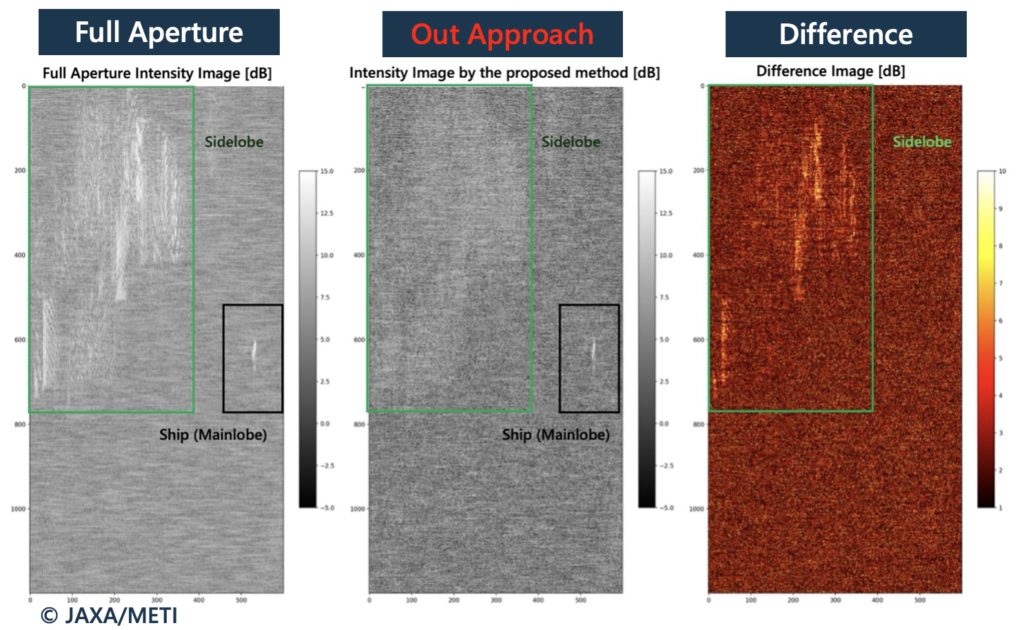
Comparison of maritime (vessel) imagery from ALOS PALSAR: Conventional method (left), proposed method with “Eclipse band” (center), and their difference (right)
Video: Demonstrating noise reduction strictly within the target areas by controlling shadows in the received signals © JAXA, METI
▶ Potential Applications
This method can be seamlessly integrated into existing pipelines as a post-processing step for SAR data. With a view toward collaboration with SateAIs™, our proprietary satellite-and-AI analysis brand, we aim to further enhance the utility and value of SAR satellite data. Furthermore, following the full establishment and validation of the methodology, we plan to submit our findings to an international peer-reviewed journal.
Conference Presentation
- Conference: JpGU-AGU Joint Meeting 2026( https://www.jpgu.org/meeting_j2026/ )
- Session: S-TT49 Synthetic Aperture Radar and its Applications
- Presentation Title: Eclipse band: Reducing SAR azimuth ambiguity by cross partially-missing-band synthetic aperture processing technique
- Date: Friday, May 29, 2026
- Presenter: Shusuke Yasui (Space Shift, Inc.)
- Co-authors: Hiro Shiotani, Kazufumi Motomura, Naruo Kanamoto (Space Shift, Inc.), Fumiyo Ogushi (NV5 Geospatial Solutions)
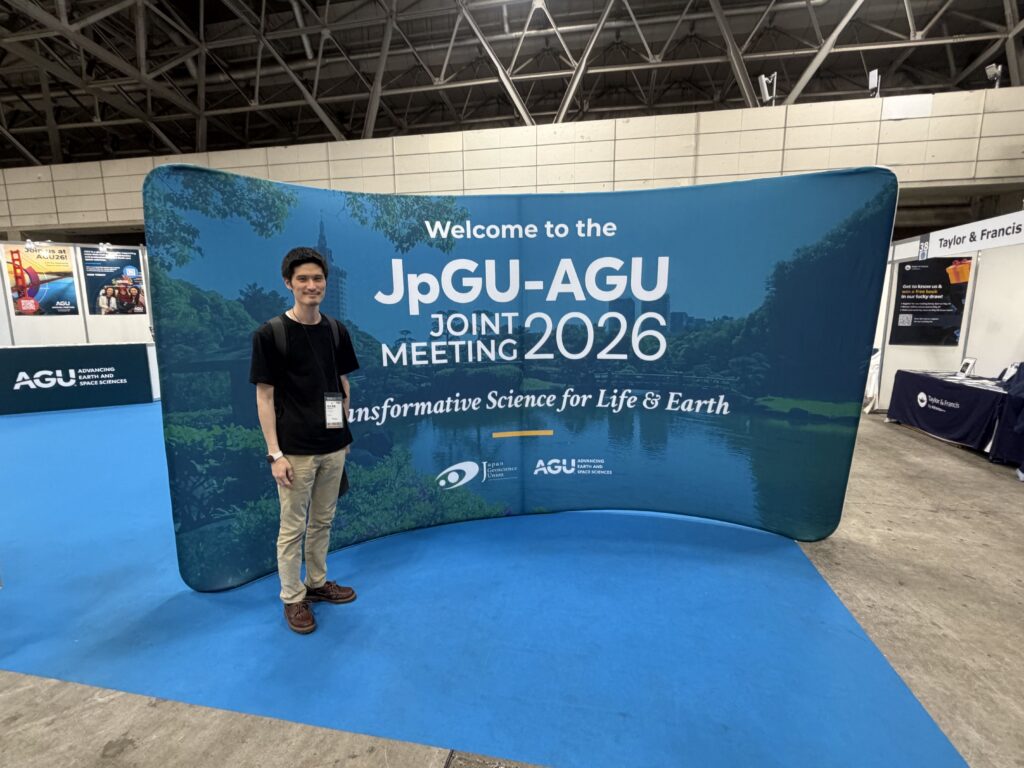
hoto: Our presenter, Yasui, speaking at JpGU-AGU 2026
Patent Information
- Filing Date: April 28, 2026
- Status: Patent Pending [ Filed and under examination ]
Acknowledgments
This study utilized ALOS-4 data provided by the Japan Aerospace Exploration Agency (JAXA) under the collaborative research framework of the 4th Earth Observation Research Announcement (EORA). [ https://earth.jaxa.jp/ja/research/cooperation/ra4/index.html ]
Data Credits
- ALOS PALSAR: © JAXA, METI (Publicly available data)
- ALOS-4 PALSAR-3: © JAXA (Distributed under EORA)
Related Articles: https://www.spcsft.com/news/3895/
Inquiries regarding this release:
Space Shift, Inc. (Attn: Yasui, Motomura)
Contact Us